Pressure is one of the most fundamental variables in industrial processes. Whether you’re monitoring fluid level in a tank, ensuring safety in a boiler, or controlling airflow in an HVAC system, accurate pressure data is critical.
The device responsible for translating this physical force into usable electronic data is the pressure transmitter.
If you’re an engineer or plant manager, understanding what a pressure transmitter is and how it functions is essential for maximizing efficiency and compliance. This guide breaks down the technology and its indispensable role in industry.
The Fundamental Role of the Transmitter
A pressure transmitter acts as a bridge between the physical world and the digital control system (PLC or SCADA).
The Definition and Function
A pressure transmitter is an electronic instrument that measures the pressure of a liquid or gas and outputs a proportional electrical signal.
Transducer vs. Transmitter
For a technical audience, this distinction is key:
- Pressure Transducer: Measures pressure and converts the mechanical force into a raw, low-level electrical signal (e.g., a voltage).
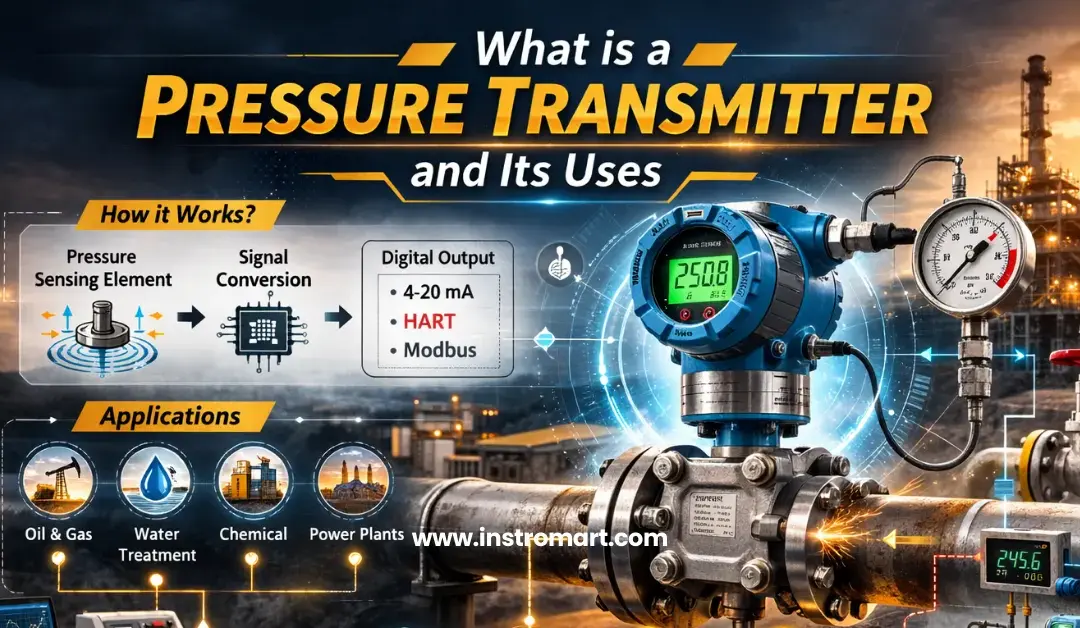
- Pressure Transmitter: Takes that raw signal, conditions it, and converts it into a standardized, high-level signal (e.g., 4-20mA or Modbus) that can be reliably transmitted over long distances to a central control system.
How a Pressure Transmitter Works
All pressure transmitters rely on a core sensing element that converts physical force into a measurable electrical value.
The Sensing Element (The Diaphragm)
Most modern industrial transmitters use a metallic or ceramic diaphragm. When pressure is applied, this diaphragm deflects slightly.
The Wheatstone Bridge Principle
This deflection is measured using strain gauges arranged in a Wheatstone bridge circuit. As the diaphragm moves, the electrical resistance in the strain gauges changes, generating a precise, measurable change in voltage proportional to the applied pressure.
The Output Signal
The internal electronics then process this raw voltage into a standardized output signal.
The 4-20mA Standard
The 4-20mA current loop is the most common output. It’s highly resistant to electrical noise and can transmit signals over long cable runs without loss of accuracy. The 4mA signal represents the zero point (e.g., 0 PSI), and the 20mA signal represents the full-scale range (e.g., 100 PSI).
Key Types of Pressure Measurement
When selecting a transmitter, defining the type of pressure you need to measure is the first step.
Gauge Pressure (Relative)
Gauge Pressure is the most common measurement. It measures pressure relative to the surrounding atmospheric pressure.
- Application: Tire pressure, vessel pressure (e.g., a tank), hydraulic line pressure. A reading of 0 PSI gauge means the pressure inside is equal to the pressure outside.
Absolute Pressure
Absolute Pressure measures pressure relative to a perfect vacuum (0 PSIA).
- Application: Used when atmospheric pressure changes (like altitude) could affect the measurement, such as in vacuum pumps or scientific applications.
Differential Pressure (DP)
Differential Pressure is the measurement of the pressure difference between two separate points.
- Application: Used to monitor flow across an orifice plate, filter status (clogging), or hydrostatic level measurement. DP transmitters have two sensing ports.
Essential Industrial Applications
What is a pressure transmitter’s true value? It’s the diversity of its essential applications across every sector.
HVAC and Building Automation
DP transmitters are used to measure the difference in air pressure across filters, indicating when a filter is clogged and needs replacing. They are also used to maintain precise air flow and pressure in clean rooms or critical building environments.
Process Control (Chemical, Oil & Gas)
Transmitters monitor critical pressures in pipelines, reactors, and distillation columns. Maintaining exact pressure values is key to process stability, safety, and product quality.
Level Measurement (Hydrostatic Pressure)
In large tanks or reservoirs, a pressure transmitter placed at the bottom measures the head pressure of the fluid column above it. Then, it converts this hydrostatic pressure reading directly into the liquid level.
Conclusion: The Backbone of Control
A pressure transmitter is far more than a simple sensor; it is the backbone of industrial control and safety systems.
Understanding what is a pressure transmitter and knowing the correct type (Gauge, Absolute, or Differential) to deploy ensures you get accurate, reliable data. This data is the foundation for optimizing efficiency, preventing component failure, and maintaining regulatory compliance.
Get the Right Transmitter for Your Process. Talk to an Instromart Expert.