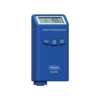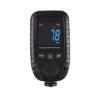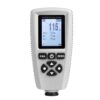
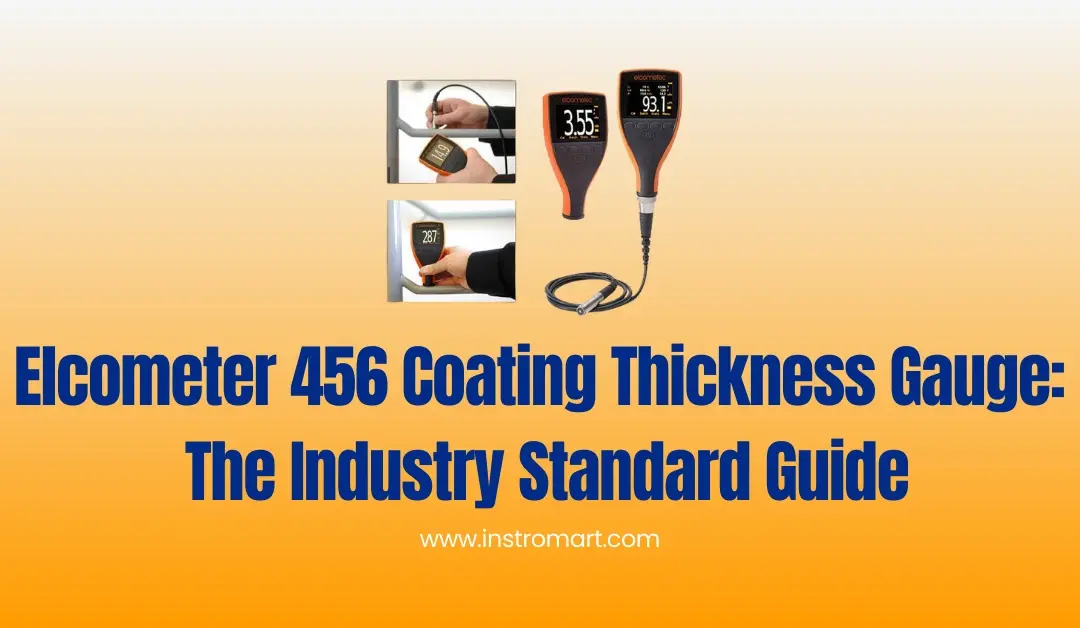
For Non-Destructive Testing (NDT) professionals and Quality Control (QC) managers, measuring Dry Film Thickness (DFT) is a critical compliance checkpoint. Inaccurate measurement risks premature coating failure, warranty invalidation, and costly rework.
The Elcometer 456 coating thickness gauge has established itself as the gold standard in this field. It is known globally for its speed, durability, and user-friendly interface.
This definitive guide explores the technical features and operational benefits that make the Elcometer 456 an indispensable tool for verifiable quality.
Why the Elcometer 456 is the Industry Benchmark
The gauge’s reputation is built on reliability and performance, especially in demanding industrial environments.
Unrivaled Speed and Accuracy
The Elcometer 456 delivers highly repeatable readings at exceptional speeds—often over 70 readings per minute. Consequently, this high-speed performance significantly reduces inspection time in the field.
Extreme Durability
The gauge features a robust, impact-resistant design. Furthermore, it often meets standards like IP64 equivalent, ensuring protection against dust and splashing water, which is necessary for fieldwork.
Key Features of the Elcometer 456
The 456’s design focuses on simplifying complex measurement tasks and ensuring data integrity.
The Measurement Principle (Elcometer 456 Coating Thickness Gauge)
The gauge operates on two core principles: Magnetic Induction (for non-magnetic coatings on ferrous, or steel, substrates) and Eddy Current (for non-conductive coatings on non-ferrous substrates like aluminum). The best models combine both (FN models).
Memory and Data Management (Elcometer 456 Coating Thickness Gauge)
The Elcometer 456 coating thickness gauge excels in data logging. It can store thousands of readings in multiple batch folders, allowing QA professionals to manage extensive inspection routes easily.
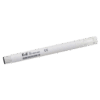
Interchangeable Probes (Elcometer 456 Coating Thickness Gauge)
The flexibility of interchangeable probes—ranging from straight, standard probes to specialized right-angle or telescopic probes—allows the Elcometer 456 coating thickness gauge to measure thickness accurately in awkward or hard-to-reach areas.
FAQs for Inspection Professionals
These are the common questions professionals ask when specifying the Elcometer 456.
Q: What is the maximum thickness the 456 can measure?
A: Maximum thickness varies significantly by the probe type selected. Higher-range probes can measure coatings up to $30 \text{ mm}$ ($1200 \text{ mils}$), suitable for thick fireproofing or specialized linings.
Q: Does the gauge need calibration?
A: Yes. While the gauge is stable, accurate compliance requires Zero Calibration on the uncoated substrate and Foil Verification using certified shims to confirm linearity across the measurement range.
Q: Can it measure both steel and aluminum?
A: Yes. The ‘FN’ models incorporate both Magnetic (Ferrous) and Eddy Current (Non-Ferrous) technologies, automatically switching the measurement principle depending on the underlying metal.
Q: What is the benefit of its high reading speed?
A: The high reading speed allows inspectors to take significantly more readings within a defined area. Consequently, this increases the statistical accuracy of the average DFT measurement, reducing the risk of false compliance reports.
Conclusion: Verifiable Quality
The Elcometer 456 coating thickness gauge remains the definitive choice because it delivers speed and accuracy without compromising ruggedness. Furthermore, its powerful data management capabilities ensure your measurements are not only accurate but also fully auditable.
Therefore, investing in the Elcometer 456 coating thickness gauge is investing in verifiable quality, minimizing future liability and rework costs.
Secure Your Inspection Accuracy. Talk to an Instromart Expert.
We specialize in supplying and calibrating the full line of Elcometer gauges and probes to meet your specific compliance standards (ISO, ASTM, SSPC).
- Contact Us for Calibration Services