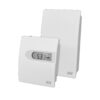
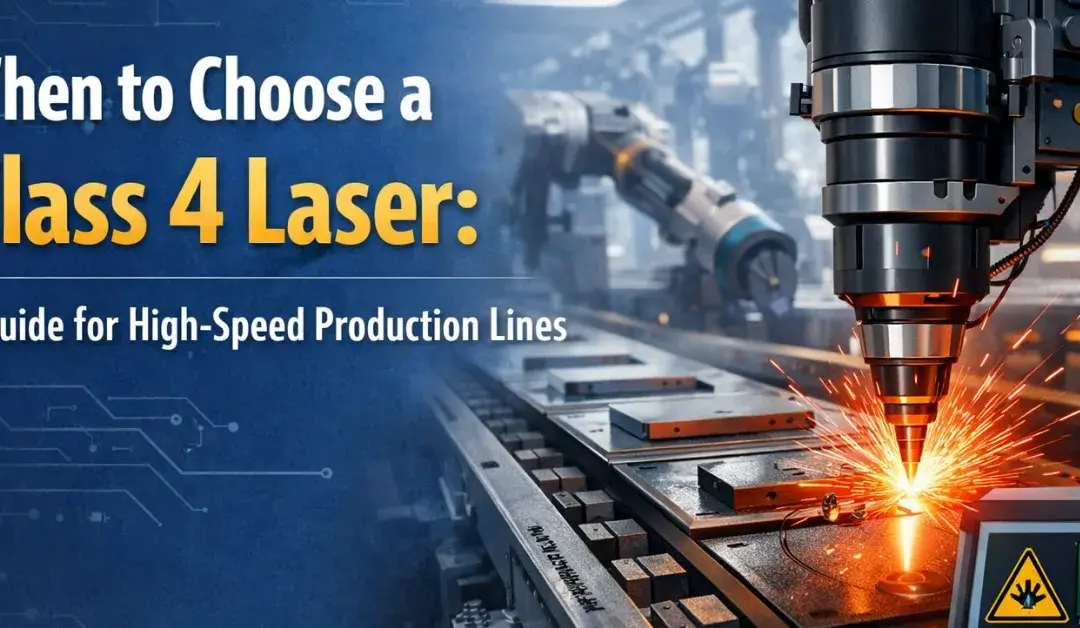
If you have been researching laser markers, you know you have two choices: a Class 1 (a safe, enclosed box) and a Class 4 (an open, component system).
The ECO Laser Class 1 is a finished “product.” You plug it in and use it.
The ECO Laser Class 4 is an “engine.” It’s the bare, powerful laser component, and it’s sold to you with the understanding that you will build the safe “car” around it.
Why would anyone take on that extra work? Because of three specific, high-value reasons.
1. You need to integrate with an automated line
This is the #1 reason. You don’t have an “operator.” You have a conveyor belt, a robot, or a PLC.
- You need “marking-on-the-fly”: Your parts are moving, and they’re not stopping. A production line laser marking system is designed to be mounted over a conveyor and mark parts as they pass by.
- It’s part of a robotic cell: A robot arm presents the part, the laser marks it, and the robot moves it to the next station.
- It’s tied to your controls: The “start” signal comes from your factory’s main PLC, not a human pushing a button.
If your process is automated, you need the flexibility of a Class 4 laser component.
2. Your Parts are Too Big (or Awkward) for a Box
A Class 1 system is limited by the size of its enclosure. You can’t fit a car door, a 20-foot pipe, or a welded chassis inside a desktop box.
You need a Class 4 system when the part is too big to “bring to the laser.” Instead, you bring the laser to the part.
With a Class 4 laser head, you can mount it on a gantry, a robotic arm, or a custom-built fixture to mark parts of (literally) any size, at any angle.
3. You Need Maximum Speed and Customization
A Class 4 laser gives you total control. You’re not limited by a pre-built enclosure.
Need to mount the laser head upside down? Go for it.
Need to put two laser heads side-by-side to mark two parts at once? You can.
Need to build a custom, high-speed rotary-axis system? A Class 4 is your starting point.
When you’re building a highly custom, high-speed machine, you need the ECO Laser Class 4 as a flexible component, not a restrictive product.
The Big Catch: You Are Now the Safety Manager
This is the part where we are brutally honest. The moment you buy a Class 4 laser, you are personally responsible for building a Class 1-equivalent safe system.
The ECO Laser Class 4 is cheaper as a component, but your total project cost will include:
- A Custom Safety Enclosure: A light-tight, guarded box you must design and build.
- Safety Interlocks: Door switches and light curtains that immediately cut power to the laser if a human enters.
- Operator Training & PPE: Mandatory laser safety goggles for everyone in the area.
- A Fume Extraction Plan: You must engineer a way to safely vent the fumes.
This is a serious laser safety integration project. It’s not a suggestion; it’s a legal and safety requirement.
So, is the ECO Laser Class 4 Right for You?
The decision is simple.
- Choose the ECO Laser Class 1 if you need a “solution” to mark parts on a workbench.
- Choose the ECO Laser Class 4 if you need a “component” to integrate into a custom-built, automated, high-speed production line.
At Instromart, we’re not just box-shippers. We are integration experts. We can help you determine the right path forward, whether it’s a simple, safe workstation or the right laser head for your complex automation project.
Contact our engineers today to discuss your production line and get a quote on the right laser for your project.
Frequently Asked Questions (FAQ)
Q1: Is a Class 4 laser more powerful than a Class 1?
Not necessarily. The laser inside is often identical. The “Class” number refers only to the safety enclosure, not the power.
Q2: What is the main cost of a Class 4 laser?
The laser component is cheaper. The total project cost (for custom engineering, safety guarding, and integration) is often much higher than buying a pre-built Class 1.
Q3: Can I just put up warning signs for a Class 4 laser?
Absolutely not. Operating an open Class 4 laser without a proper, interlocked safety enclosure is a major safety violation, illegal in most countries, and extremely dangerous.