In modern manufacturing, traceability isn’t optional. From aerospace to automotive, you need to mark parts with permanent serial numbers, date codes, and 2D data matrices.
But these marks must survive harsh conditions, from shot-blasting and painting to a lifetime of industrial wear. This is where dot peen marking excels.
So, what is dot peen marking and how does it create a mark that can’t be removed? This guide from Instromart breaks down the technology, its benefits, and where it’s used.
The Quick Answer: What is Dot Peen Marking?
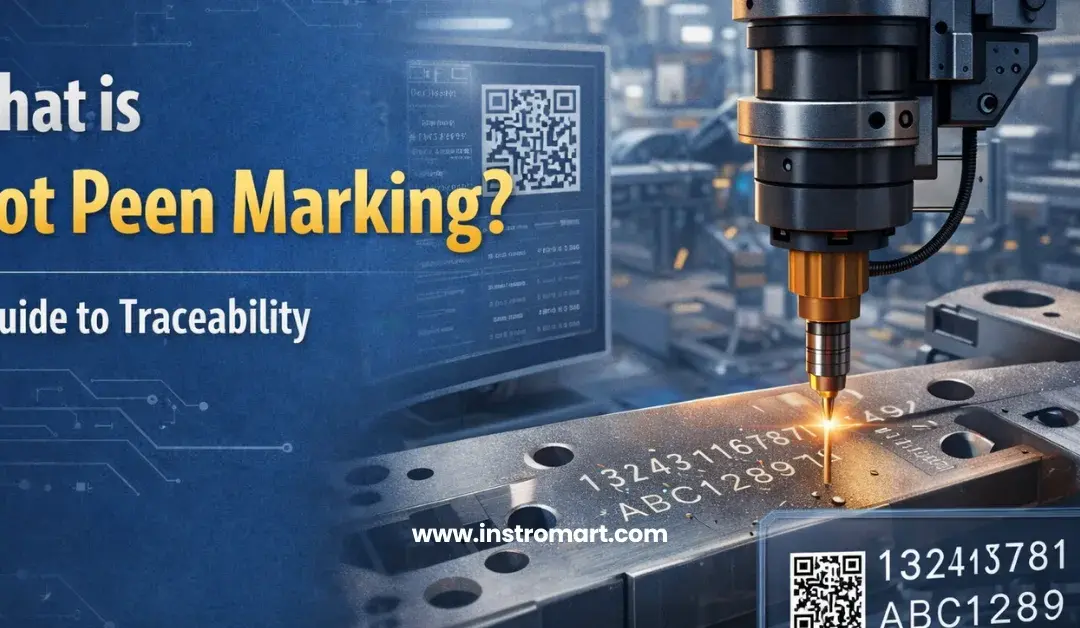
Dot peen marking (also known as “pin marking” or “pin stamping”) is a direct part marking (DPM) process.
It uses a hardened stylus (or “pin”) to physically indent a series of precise dots onto a surface. These dots are spaced closely together to form human-readable characters, logos, and machine-readable 2D codes.
Think of it as a high-tech, automated hammer and chisel, creating a mark that is physically impressed into the material.
How Does Dot Peen Marking Work?
The system is a clever combination of robust mechanics and precise software. There are three key components.
1. The Stylus (The “Pin”)
The “business end” of the marker is a stylus, which is typically made of extremely hard tungsten carbide. This pin is what makes contact with the part and creates the indent.
2. The Mechanism (The “Hammer”)
The stylus is fired from its housing to strike the material. This action is controlled in two main ways:
- Electromagnetic: An electric coil drives the pin forward. This is common in modern portable units (like our Instromart MNSB-TC) as it only requires electricity.
- Pneumatic (Air-Powered): Compressed air is used to fire the pin. This method is common in older or very deep-marking benchtop systems.
3. The Software (The “Brains”)
The user types a serial number or loads a 2D code into the controller. The software then plots the X/Y coordinates for every single dot needed to create that shape. It fires the pin rapidly as the marking head moves, “connecting the dots” to form the final, clear mark.
Key Benefits: Why Choose Dot Peen?
B2B customers choose dot peen for three main reasons: permanence, versatility, and cost.
Benefit 1: Extreme Permanence
Because the mark is a physical indentation, it cannot be rubbed off, washed away, or removed with solvents. It survives post-processing like painting, galvanizing, and heat treating.
Benefit 2: Marks on Almost Any Surface
This is where dot peen truly outperforms other methods.
- Hard Materials: It can easily mark hardened steel (up to 63 HRC) that a laser might struggle with.
- Uneven Surfaces: The pin has a “throw” (it can travel), allowing it to mark on curved pipes or rough castings.
- Imperfect Conditions: It doesn’t care if a surface is slightly oily, dusty, or dirty.
Benefit 3: Low Cost of Ownership
Dot peen systems are robust. They have no “consumables” like ink or labels. The only wear part is the stylus, which is affordable and easy to replace.
Common Applications: Where is Dot Peen Used?
You will find dot peen marks in any industry that requires “cradle-to-grave” traceability.
Automotive
Marking VINs on chassis, serial numbers on engine blocks, and codes on gearbox components.
Aerospace
Creating permanent traceability marks on turbine blades, landing gear, and structural components.
Oil & Gas
Marking pipes, valves, and flanges for compliance and field identification.
Heavy Fabrication & Defense
Marking large steel beams, vehicle frames, and equipment for permanent identification.
Frequently Asked Questions (FAQ)
Q: What’s the difference between dot peen and pin stamping?
A: Nothing. They are two different names for the exact same process. “Dot peen” is the more technical term.
Q: Is dot peen marking loud?
A: It does make a “buzzing” sound as the pin strikes the metal. The volume depends on the material, but it’s generally considered safe. For very high-volume lines, an enclosure may be used.
Q: Can dot peen mark plastics?
A: Yes. By adjusting the force level, a dot peen marker can permanently indent hard plastics without cracking them, which is common for tool housings and industrial tags.
The Final Verdict: Your Go-To for Durability
If you’re asking what is dot peen marking, the simplest answer is: it’s the most durable, reliable, and versatile marking technology for industrial parts.
Dot peen is built for force and permanence, just like lasers are built for speed and finesse. It is the workhorse of industrial traceability.
Explore Instromart’s Dot Peen Solutions
See how a dot peen marker could solve your traceability challenges. Explore our full range of benchtop and portable systems, including the battery-operated MNSB-TC.