In any industrial hydraulic or lubrication system, oil is the lifeblood. But there’s a silent killer that can destroy your most valuable assets from the inside out: water contamination.
Water in oil isn’t a minor issue; it’s the root cause of catastrophic equipment failure. It accelerates oxidation, causes corrosion, reduces lubrication, and leads to costly downtime.
In the past, the only way to check for moisture was with periodic, offline lab tests. This “snapshot” approach often misses the problem until it’s too late.
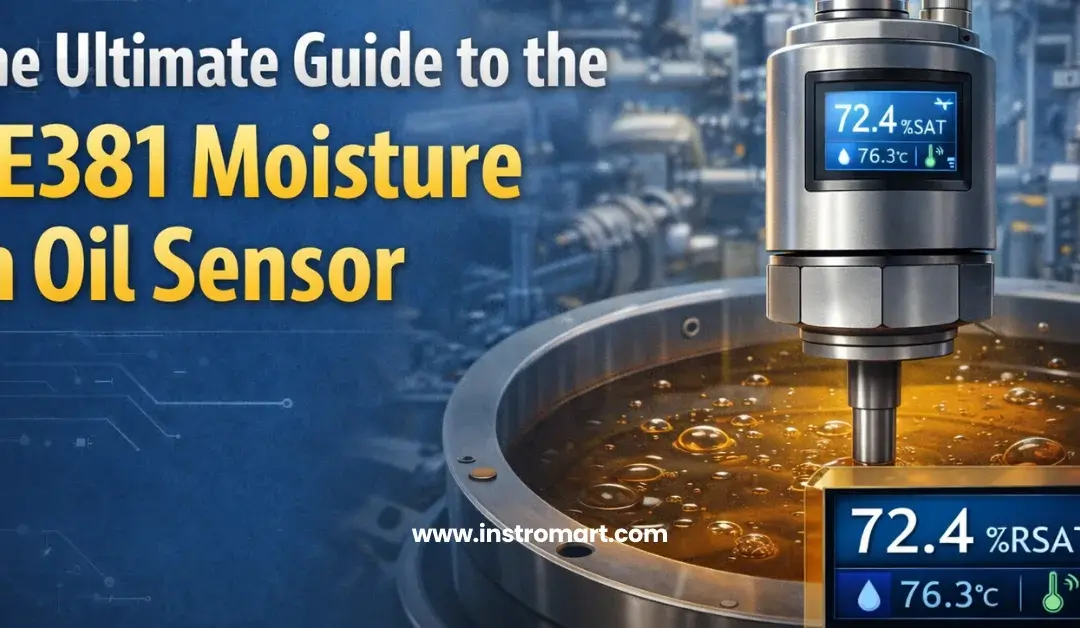
This is why real-time monitoring with a dedicated transmitter like the EE381 Moisture in Oil Sensor has become a cornerstone of modern predictive maintenance.
This guide from Instromart explains the technology, the benefits, and the applications of this critical industrial tool.
Why Water in Oil is a Catastrophic Problem
Before we discuss the solution, we must respect the problem. Water contamination is not a single issue; it triggers a chain reaction of failures.
1. Accelerated Oxidation and Sludge
Water dramatically speeds up the oil’s oxidation process. This breaks down the oil’s additives, creates acidic byproducts, and forms sludge and varnish that clog filters, valves, and lines.
2. Reduced Lubrication and Wear
Water displaces oil on metal surfaces, leading to a loss of the critical lubrication film. This results in direct metal-on-metal contact, causing severe wear on bearings, pumps, and gears.
3. Corrosion and Rust
“Free” water (which we’ll explain below) allows rust to form on internal components. These rust particles then circulate through the system, acting like sandpaper and causing even more damage.
The Cost of Failure
For assets like a wind turbine gearbox or a hydraulic press, the cost of an oil-related failure isn’t just the repair. It’s the tens of thousands (or millions) in lost production and downtime.
The “aw” vs. “ppm” Problem: Why Old Metrics Fail
This is the most critical concept to understand. Not all moisture measurements are created equal.
What is ppm (Parts Per Million)?
- ppm measures the total, absolute mass of water in the oil.
- The Problem: A “safe” ppm level in one oil (e.g., mineral oil) could be a “catastrophic” level in another (e.g., synthetic ester oil). This is because different oils have different saturation points.
What is Water Activity (aw)?
- Water Activity (aw) measures the relative saturation of the oil, on a scale of 0 (bone dry) to 1 (fully saturated).
- This is the metric that matters.
- An aw of 0.6 or higher means there is enough “free water” to start causing rust and microbial growth, regardless of the ppm value.
The Sponge Analogy
Think of oil as a sponge.
- ppm is the total grams of water in the sponge.
- aw is how close the sponge is to dripping.
A small kitchen sponge (low saturation point) might drip with only 50g of water. A giant industrial sponge (high saturation point) could hold 500g and still feel dry.
The dripping sponge is what causes damage. The EE381 Moisture in Oil Sensor is designed to measure water activity (aw) directly, telling you how close your “sponge” is to dripping.
A Deep Dive: Key Features of the EE381 Moisture in Oil Sensor
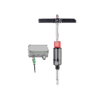
The EE381 Moisture in Oil Sensor is a purpose-built industrial transmitter. It’s not a delicate lab instrument; it’s a robust tool designed for 24/7 online monitoring.
Measures the Parameters That Matter
The EE381 provides three critical, real-time outputs:
- Water Activity (aw): The most important value for predicting failure.
- Temperature (T): Essential, as temperature changes the oil’s saturation point.
- Calculated Water Content (ppm): By knowing the oil-specific parameters, the EE381 can also calculate the absolute ppm, giving you both metrics at once.
Built for Industrial Environments
- High Pressure: The sensor is rated for up to 20 bar (290 psi), making it perfect for most hydraulic and lubrication lines.
- High Temperature: It can operate in oil up to 120°C (248°F), covering a huge range of applications.
- Robust Housing: A stainless steel (IP65) housing protects it from the harsh conditions of a factory floor or an outdoor transformer.
Easy Installation and Integration
The EE381 outputs its data via two standard 4-20mA signals and an RS-485 (Modbus RTU) digital interface. This makes it easy to connect to any PLC, SCADA system, or data logger.
A key feature is the optional ball valve assembly. This allows you to install or remove the sensor for calibration without shutting down the entire system, saving you critical downtime.
Where to Use the EE381 Moisture in Oil Sensor (Applications)
The EE381 Moisture in Oil Sensor provides high-value data for any high-value, oil-lubricated asset.
1. Transformer Monitoring (Power & Utility)
In a power transformer, oil is used for cooling and insulation. Moisture dramatically reduces the oil’s dielectric strength, leading to arcing and catastrophic failure. The EE381 is essential for monitoring transformer oil health.
2. Hydraulic Systems (Manufacturing & Mobile)
In a hydraulic press, injection molding machine, or heavy mobile equipment, water in the hydraulic fluid causes valves to stick and pumps to fail. The EE381 provides an early warning before a line stoppage.
3. Lubrication Systems (Turbines, Gearboxes)
This is a major application. The gearboxes in wind turbines, paper mills, and industrial machinery are subject to immense stress. The EE381 monitors the lube oil to ensure bearings and gears are protected, extending the asset’s life by years.
Frequently Asked Questions (FAQ) about the EE381
Q: What types of oil can the EE381 monitor?
A: The EE381 Moisture in Oil Sensor is ideal for mineral oils, synthetic oils (like ester oils), and insulation oils. The oil-specific parameters can be programmed into the device for accurate ppm calculation.
Q: How often does the sensor need to be calibrated?
A: The EE381 is built for long-term stability. A typical calibration interval is 1-2 years, depending on the application. The easy-to-use ball valve option makes this process simple.
Q: Can the EE381 detect “free water”?
A: Yes, indirectly and most importantly. As the oil approaches saturation (aw = 1), “free water” begins to form. The EE381’s aw reading is the best indicator that free water is present or about to form.
Bottom line: From Reactive to Predictive
Offline oil analysis is a “snapshot in time.” It’s an autopsy that tells you what was wrong.
An online EE381 Moisture in Oil Sensor is a 24/7 EKG for your most critical machinery. It provides a real-time, continuous data stream that allows you to see problems as they develop.
It allows your maintenance team to stop guessing and start knowing. You will no longer change oil based on a calendar; you will change it when the data tells you to.
This is the very definition of Predictive Maintenance. It’s the key to saving millions in downtime and repair costs.
Protect Your High-Value Assets. Talk to an Instromart Expert.
Are you ready to stop reacting to failures and start predicting them? Contact our team of technical experts today. We can analyze your application and configure an EE381 Moisture in Oil Sensor system that protects your most critical assets.
- View the EE381 Sensor Details
- Contact Us for a free consultation